


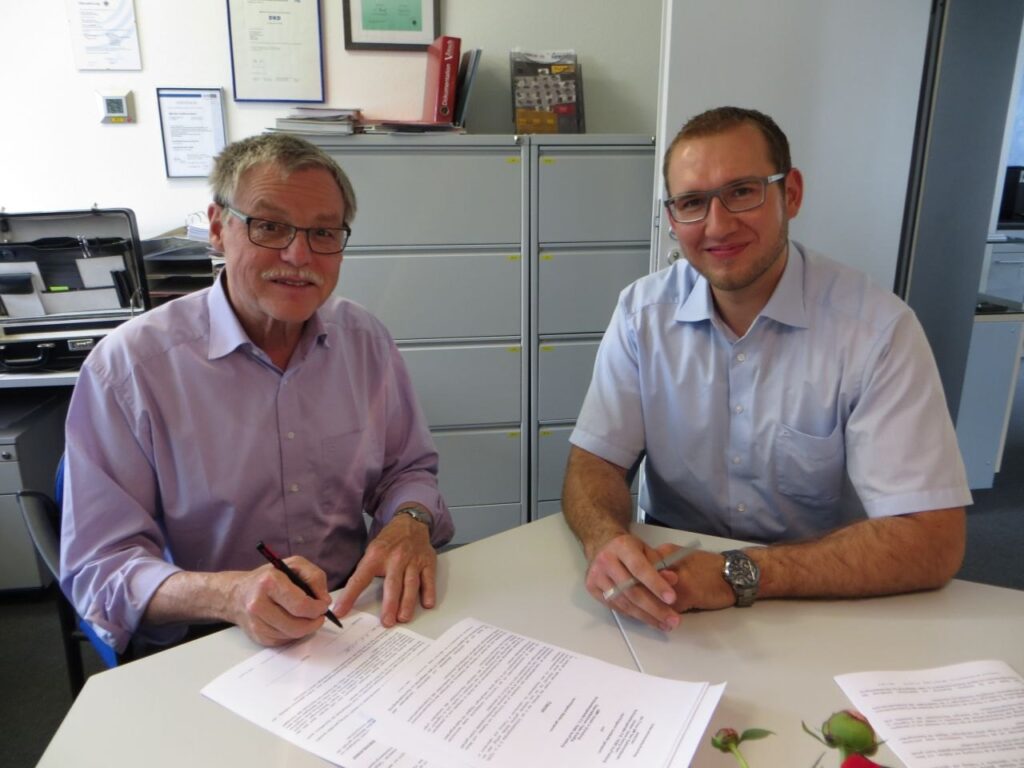
Exactly 10 years ago: a contract on the table, a rose next to it—and a signature that changed everything.
On July 1, 2016, I took over the QM-Herr Calibration Service from Hans-Georg Herr—the photo shows the moment the contract was signed. Over many years, Mr. Herr had built the laboratory into a well-established name in measurement and testing technology. I was 31 at the time, an electronics technician and business administrator, and I made a handful of promises: to continue the business in his name, to take over the team, and to maintain the DAkkS accreditation and quality standards. Mr. Herr remained with us afterward as laboratory manager and quality management representative—for which I remain grateful to this day.
Business Succession in a Calibration Laboratory: What Really Matters
We explained how the succession came about back then in our article “Successful Ad—Seeking a Successor, Offering a Business.” Today, ten years later, I have a clearer understanding of what matters most when taking over a calibration laboratory—and why this type of succession differs from others.
A calibration laboratory does not sell a product; rather, it sells trust in measurement results. Customers rely on their test equipment to measure accurately, on every value being fully traceable to national standards, and on the calibration certificate standing up to an audit. This trust cannot simply be transferred through a sales contract. For me, therefore, three things were crucial:
- Continuity within the team: A calibration laboratory’s expertise resides in the minds and hands of its employees. Taking over and retaining the team was the most important prerequisite.
- Continuity in Quality Management: The fact that Hans-Georg Herr remained on board as laboratory director and quality management representative ensured a seamless transition for customers and the accreditation body.
- Accreditation as the Foundation: DAkkS accreditation according to DIN EN ISO/IEC 17025 is not just a certificate on the wall for a calibration laboratory, but proof of its competence—with regular assessments, validated procedures, and reliable measurement uncertainties. Maintaining this accreditation was non-negotiable from the very beginning.
Ten Years Later: What Has Become of the Lab
Ten years later, I can say: It worked. The number of calibrations has grown from about 2,000 per year to over 42,000—more than twenty times as many. In total, we have calibrated well over 239,000 pieces of test equipment during this time.
- 2016: Takeover of the QM calibration service; approximately 2,000 calibrations per year
- 2022: Integration of the Laboratory for Measurement and Calibration Technology (LMK)— learn more here
- 2025: Over 42,000 calibrations per year
- Today: DAkkS-accredited calibration laboratory (D-K-20571-01-00) headquartered in Offenburg, with two additional locations and approximately 35 employees
And here’s what I’m most proud of: Some devices have been coming back to us time and again for over 20 years. That’s trust we earn anew every day—with every single calibration certificate.
For our anniversary: the #100Messmittel series
To celebrate our anniversary, we want to show you what lies behind the word “calibration.” Under #100Messmittel, we’ll introduce you to 100 measuring and testing devices: what they can do, how we calibrate them, and where they’re actually needed in manufacturing, production, and quality assurance.
Each episode follows the same structure: What is it? – How do we calibrate it? – Where is it used in practice? We’ll include real data from our lab and real photos from our everyday lives. Let’s start with the classic of all classics: No. 1—the vernier caliper.
Thank you
Thanks to Hans-Georg Herr, my team, and all of our customers. Here’s to the next ten years.
Falko Kreißig, Owner and Managing Director of QMK GmbH