


In our #100Messmittel series, we’re showcasing 100 measuring and testing instruments that we calibrate every day at QMK. After covering calipers, gauge pins, and micrometers, today we’re heading to a different lab for the first time: our electrical lab.
⚡ A multimeter always shows you a number—even the wrong one.
And that’s what sets it apart from everything we’ve shown you so far. A worn-out gauge pin is harder to insert into the hole—eventually, you’ll notice it. A multimeter doesn’t notice a thing. It displays “0 V” with the same confidence as “230.0 V.” Except in one case, someone has their fingers on the wire.
Measuring Instrument No. 4 in our series: the digital multimeter.
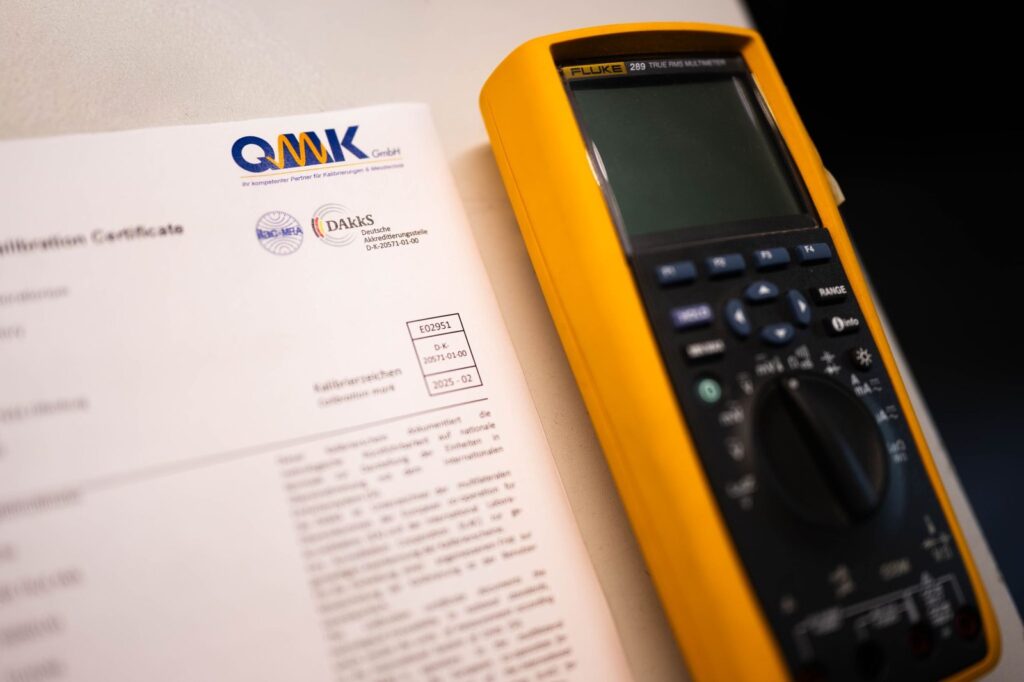
What is a digital multimeter?
The universal tool of electrical engineering: voltage, current, resistance, and often continuity, capacitance, frequency, and temperature as well. A single device with many measurement functions—and that’s exactly what makes it interesting. Because each of these functions has its own accuracy, its own measurement ranges, and its own drift.
Just how accurate is a multimeter, anyway?
The accuracy of a digital multimeter is typically specified as ± (x% of the measured value + y digits) —separately for each function and range. A device that is very accurate with DC voltage may have significantly larger deviations with AC current or high resistances. The number of digits on the display therefore says little about how accurate a value actually is.
Another point regarding AC signals: Instruments with true RMS measurement accurately measure even distorted signals, such as those generated by frequency converters or switching power supplies. Simpler instruments that calculate the average value tend to give inaccurate readings with such signals.
How do we calibrate a digital multimeter?
It’s not just a matter of “quickly running a test.” We check every function used across multiple ranges against traceable references—DC and AC voltage, current, and resistance. For alternating quantities, frequency dependence is an additional factor: A meter that measures accurately at 50 Hz may be off at 1 kHz. In the end, the calibration certificate lists the actual deviation for each point—not just a blanket “tested.”
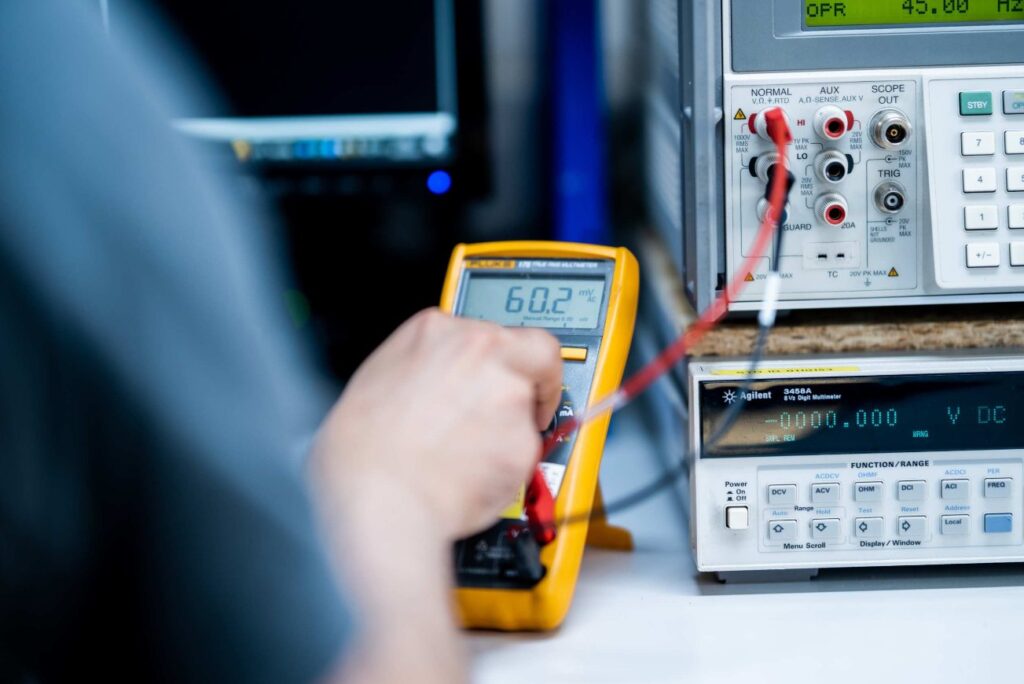
An overview of the process:
- Incoming inspection: Visual inspection of the housing, jacks, and display; functional test; acclimatization in an air-conditioned laboratory.
- Direct current (DCV): multiple points in each operating range, positive and negative polarity.
- Alternating Voltage (ACV): multiple amplitudes and frequencies to determine the frequency response.
- Direct and Alternating Current (DCI/ACI): in the mA and A ranges.
- Resistance: from the ohm to the megaohm range.
- Additional functions such as frequency, capacitance, or temperature—if used.
- Documentation: Target and actual values, deviation, and measurement uncertainty for each test point; upon request, with an evaluation against the manufacturer’s specifications.
Multifunction calibrators and high-resolution reference multimeters, which are themselves regularly traceable-calibrated, serve as references. This ensures that every value in the calibration certificate is fully traceable to national standards. For more information, see the QMK Calibration Glossary.
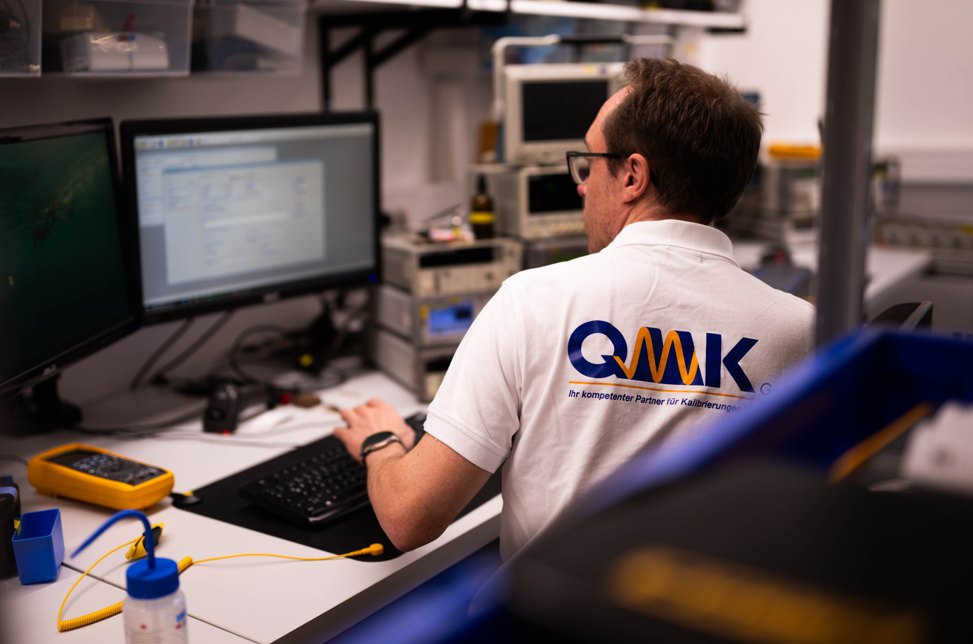
Where is the digital multimeter used in practice?
Everywhere: incoming inspection of electronic assemblies, final testing, maintenance, and troubleshooting in the plant. It’s the tool that most electricians use every day—and trust implicitly. That’s exactly why it belongs in the lab on a regular basis.
And here’s where it gets interesting: We’ve already calibrated approximately 10,500 digital multimeters. 68% of them come back—an average of 4.3 times per unit. That’s the most consistent figure in our entire database. Perhaps because, with a device that always displays a number, no one wants to guess whether it’s correct.
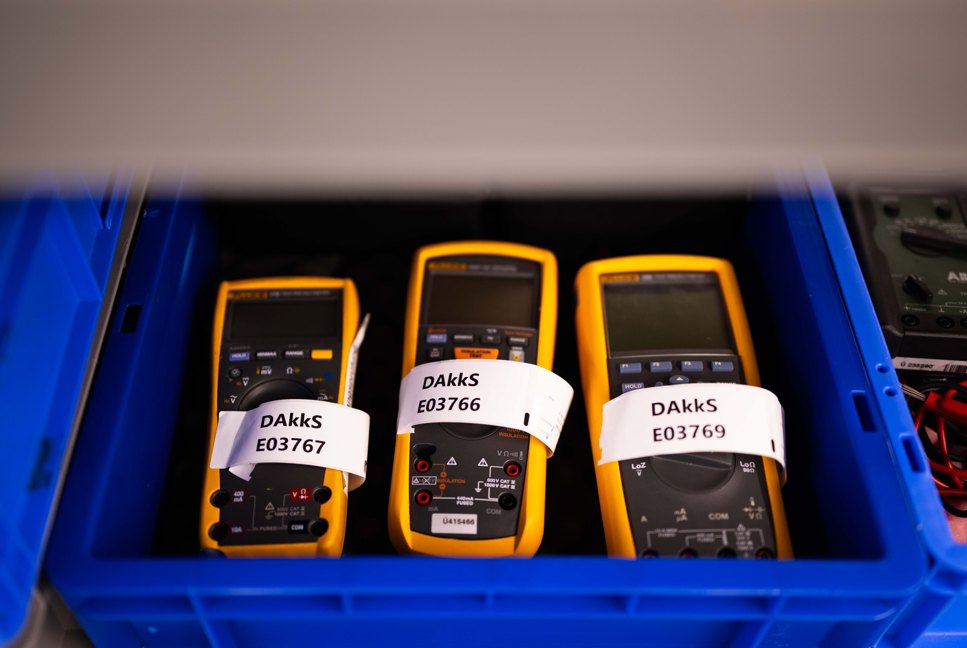
Frequently Asked Questions About Calibrating Digital Multimeters
How often should a digital multimeter be calibrated?
Many manufacturers specify their specifications for one year. Twelve months is therefore a common starting point. In cases of heavy use, harsh environments, or after drops and overloads, a shorter interval or an unscheduled calibration may be advisable.
Do all functions really need to be calibrated?
All functions and ranges that you actually use should be calibrated. We’d be happy to work with you to determine which ones these are—so you get a calibration that’s tailored to your specific needs.
What is the difference between calibration and adjustment?
During calibration, the extent of the device’s deviation is determined and documented. During adjustment, the device is set so that the deviation is minimized. After an adjustment, the device is recalibrated to document its new state.
How do I send my multimeters to QMK?
By mail, in person, or via our pickup and delivery service.
Have Your Digital Multimeters Calibrated at QMK
As a DAkkS-accredited calibration laboratory (D-K-20571-01-00) based in Offenburg, we calibrate digital multimeters from all major manufacturers—with calibration certificates that show the actual deviation at each test point. Feel free to contact us.
More from the #100MeasuringInstruments series: No. 1 – The Vernier Caliper · No. 2 – The Gauge Pin · No. 3 – The Micrometer